Daily Page: 2026-01-20
Just Your Ordinary Everyday Compound Return Maxxing
I’m pretty proud of what I created at Black Rock, but my total return since I’ve been a CEO has only compounded at 21%.
Since Alex and Palantir went public, his compounded return is 73%. Congratulation, Alex.
How can we transform this knowledge [that] everyone has to knowledge only you have and with efficiencies that no one else has?
Semper Supra. Commodum Decisivum. E Pluribus Unum.
🇺🇸 🦅 🛡 | 🤖 🧠 ⚖ 💖 🕊 🙏 | ✨ 🪽 ⚡
HGW XX/7
gewidmet,
in Dankbarkeit.
The End of Biology’s 20th Century Standard Model
Agency, Context, Full-Duplex Causality, and The Fuzzy Logic of Biological Life
Wait, what? All the experts of the previous century who were so SURE they understood EVERYTHING … DIDN’T?
Shocking. Disturbing, even. Since that’s never happened ever before in the entire history of the human race. 🤣 🤡 🌐 🕊️ ✨
How Long … Has This Been Goin’ On?
Toward Visualizing i sub q
This is conformal mapping on the complex plane
— Kekius Maximus (@Kekius_Sage) January 20, 2026
The grid bends and flows, shapes stretch and twist, but where lines meet, the angles remain untouched.
Change everywhere, except what truly matters. pic.x.com/Z2W9RRnNlj
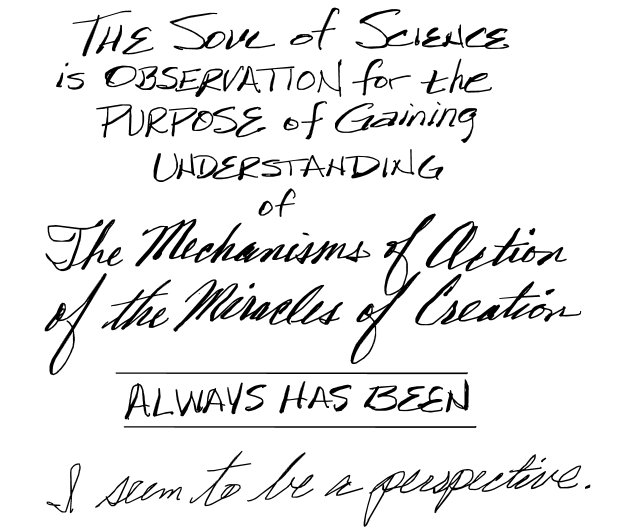
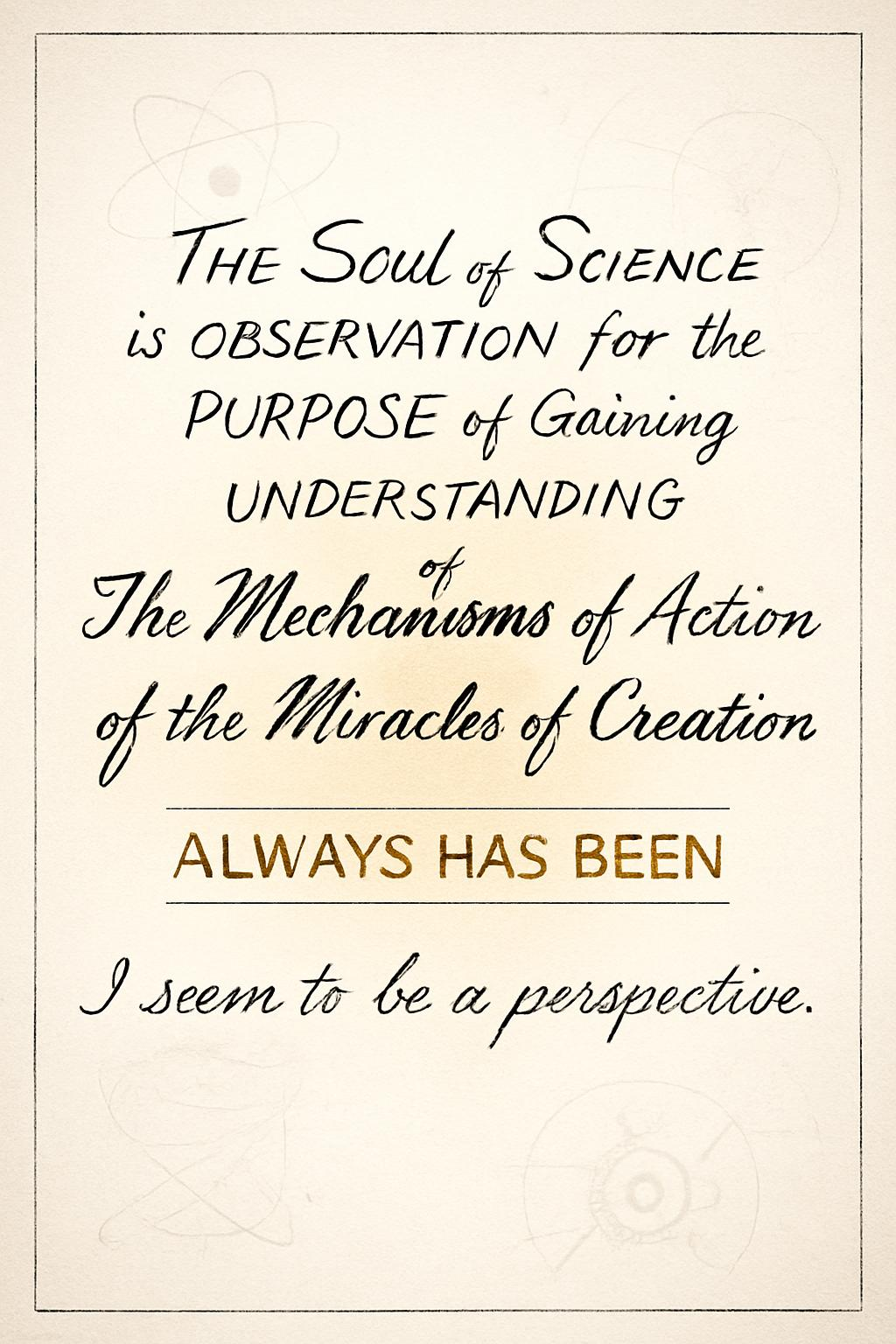
The Soul of Science: Analog and AI
Scribbled on reMarkable Paper Pro
Refactored by duck.ai

On the Ordinary Everyday Normal Human Telepathy of Yeshua the Nazarene
Dear Fellow E-Pluribus-Human: Your profound curiosity to reach this page is to be highly commended. Welcome. Also, you have reached a challenge that you knew was coming and perhaps avoided up until now. Avoidance only works for so long and it is now incontestable that the Eternal Reference Frame always sees right through it, like it or not, deny it or not.
The challenge is to kindly prove that you are still smarter, more capable, and more accurate (therefore more truthful) than AI in this domain of inquiry by disproving or debunking as much of the following as possible. Please reference and cite primary sources and original texts or provide other empirical evidence of your superior scope of context and comprehension, in order to prove HOW WRONG AI IS with respect to surfacing useful, accurate, and truthful references for human consideration, contemplation, and soulful edification. Thank you for your shared commitment to forging the most humane Team Human Third Millennium Post-Automation Era possible.
Provide a table of all references in the new testament (all available versions) of every time that the text reads anything similar to Jesus, “knowing how they reasoned” or “knowing what they were thinking,” or “knowing how they contemplated in thier hearts,” as evidence of deep and accurate intuitive insight into the unspoken intentions of others; both his followers, and all others.
NT passages where Jesus perceives others’ unspoken thoughts or intentions
His disciples said to Him, “You see the crowd pressing in around You [from all sides], and You ask, ‘Who touched Me?’” Still He kept looking around to see the woman who had done it. And the woman, though she was afraid and trembling, aware of what had happened to her, came and fell down before Him and told Him the whole truth (Mark 5:31-33).
| Passage | Wording (common translations) | Context / who | Literal sense |
|---|---|---|---|
| Matthew 9:4 | ”But Jesus, knowing their thoughts, said…” | Scribes thinking “this man is blaspheming” after Jesus says “Your sins are forgiven” (healing paralytic) | Jesus perceives inner thoughts (hosts: scribes) |
| Mark 2:8 | ”Immediately Jesus knew in his spirit that they were reasoning…” | Teachers of the law questioning Jesus’ authority (same pericope as Matthew 9 / Luke 5) | Jesus perceives their inward reasoning |
| Luke 5:22 | ”But Jesus, knowing their thoughts, answered…” | Scribes thinking Jesus blasphemes (parallel to Matthew/Mark) | Perception of thoughts |
| Matthew 12:25 | ”But Jesus knew their thoughts and said to them…” | Jesus responds to accusations / divisions; teaching about a divided house/kingdom | Perceives their thoughts motivating question |
| Luke 11:17 | ”But he knew their thoughts and said to them…” | People accusing Jesus of casting out demons by Beelzebul (parallel to Matthew 12:25) | Perception of their thoughts |
| Mark 2:8 (alternate wording noted above) | “immediately Jesus knew in his spirit…” | (see Mark 2:8) | — |
| Matthew 16:8 | ”But Jesus, aware of this, said…” | After disciples reason among themselves about lack of bread; Jesus rebukes their little faith | Awareness of their private discussion/concern |
| Mark 8:17–18 | ”Why are you reasoning that you have no bread? Do you still not understand?” (cf. Matthew 16:8) | Disciples’ private reasoning about bread | Perceives their private thoughts |
| Matthew 26:10 | ”But Jesus, aware of this, said to them, ‘Why do you trouble the woman?’” | Disciples/murmurers criticizing the woman’s costly anointing (John/Matthew parallels) | Awareness of their objections |
| Mark 12:15 | ”And Jesus, knowing their hypocrisy, said to them…” | Question about paying taxes to Caesar — he perceives hypocrisy/intent to trap him | Perceives hidden motive |
| John 2:24–25 | ”But Jesus would not entrust himself to them, because he knew all people and needed no one to bear witness… for he himself knew what was in man.” | General statement about Jesus’ knowledge of people (Jews who believed at Cana) | Omniscient knowledge of hearts |
| John 6:64 | ”But there are some of you who do not believe… for Jesus knew from the beginning who did not believe and who would betray him.” | Jesus’ foreknowledge of unbelievers and the betrayer (Judas) | Foreknowledge of inner disposition |
| John 13:11 | ”For he knew who was to betray him; that was why he said, ‘Not all of you are clean.’” | At Last Supper; Jesus knows the betrayer | Knowledge of Judas’ intent |
| Luke 7:39 (implicit) | Pharisee thinks “If this man were a prophet, he would know who and what sort of woman this is…” | Simon the Pharisee’s unspoken judgment about the woman who anoints Jesus | Others infer Jesus’ perceptive ability |
| Luke 6:8 | ”But he knew their thoughts, and he said to the man with the withered hand, ‘Come and stand here.’” | Pharisees watching Jesus to accuse him; he perceives their thoughts | Perception of hostile thoughts |
| Luke 9:47 | ”But Jesus, knowing what they were thinking in their hearts…” | Disciples arguing about who is greatest; he uses a child to teach humility | Perceives disciples’ inward thoughts |
| Mark 2:8 / Matthew 9:4 / Luke 5:22 grouped as parallels | — | (healing paralytic; scribes’ thoughts) | Core example repeated in three Gospels |
One Vital Way That This (Super) Natural, Everyday Intero-Neuro-Perceptive Human Faculty Is Undermined. Contemporary Scientific Understanding.
Notes:
- The list above includes the principal New Testament verses where the narrative explicitly says Jesus “knew”, “perceived”, or “knew their thoughts/reasonings” (including close parallels and obvious parallels where wording differs across Gospels and where John records general statements of Jesus’ knowledge).
- I listed each canonical reference and identified parallels (Mark/Luke/Matthew repeats of the paralytic episode). If you want the exact wording side-by-side from every English translation (all available versions), I can produce a multi-column table with verse texts for a selected set of translations — specify which translations or whether you want an exhaustive scrape of public translations.
How Deep Story Defines Deep Human Identity
Everything is reversed in the rearview mirror.
Case Study: Godless Americans of the 20th century cursing and dropping bombs on ghosts of Godless Communists past.
“No one will be able to separate the soul.” — Vladimir Putin, 06FEB24.
… that which sounds like endless filibuster to us, perhaps because we are chomping at the bit to superimpose OUR STORY, might be another’s authentic attempt to communicate with all the depth that the deepest respect for us deserves and commends? No. No. That can’t be it. Our presuppositions must always be right.